Feb 4, 2026 4:36:18 PM
Retail | AI | case study

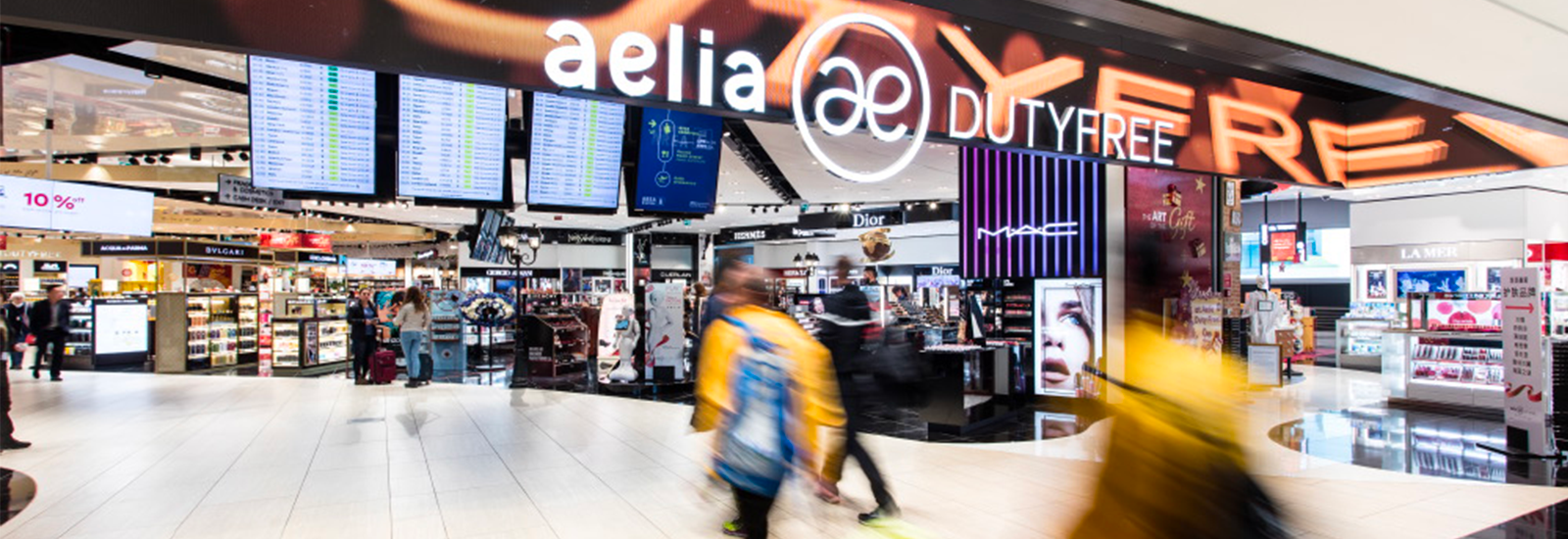


Operating retail in airports is a unique kind of complexity. High footfall. Tight margins. Constant movement. And teams spread across countries, formats, and brands.
For Lagardère Travel Retail, that complexity is amplified by scale. The group operates across more than 50 countries, managing three distinct business lines: Duty-Free, Convenience and Dining.
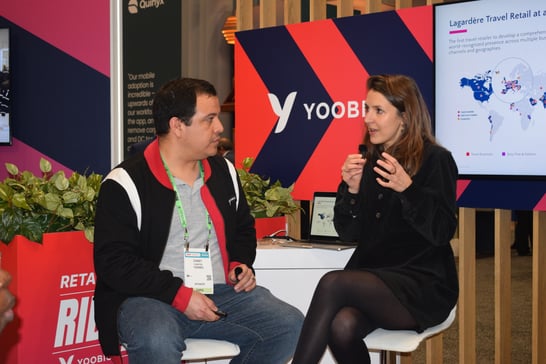
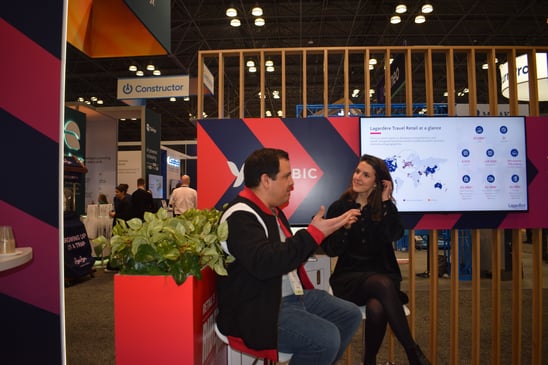
At NRF, Pauline Fradin, VP of Store Solutions & Quality, joined Casey Fuentes from YOOBIC to share how the organization is simplifying this complexity.
Lagardère approached the rollout as a replacement of systems, not an addition, creating one shared way for HQ and frontline teams to operate.
Here’s how they moved from a local pilot to a global execution standard.
Lagardère’s decentralized structure supports local agility, but it also created significant blind spots. With each country’s HQ managing operations independently, there was no consistent way to reach frontline teams or track execution.
The team identified two core friction points:
To learn more about tackling high turnover, read our guide on how to improve retail employee retention.
Lagardère deliberately started with a single-country pilot in Switzerland. The goal was to test whether a shared execution platform could improve day-to-day operations without disrupting local ways of working.
The results were decisive. After one year of use in Switzerland, the pilot delivered measurable impact:
Those outcomes gave country teams confidence and created internal momentum. As Pauline Fradin explained:
“If one, two, three countries are adopting a solution they are happy with, they can promote the solution internally. We rely on them to engage and onboard new countries.”
That peer-led momentum created a snowball effect. What began as a Switzerland pilot expanded to seven countries, and now underpins plans to scale to more than 20 countries and over 10,000 users. Lagardère has shared more detail on the Switzerland pilot and early expansion in this article.
What started as local communication became a global execution mandate.
One of the most important insights from the session was how the platform’s role evolved over time.
Phase 1: local communication and issue resolution
The first phase focused on solving a basic but persistent communication problem at the country level.
Reaching frontline staff consistently was difficult. Information was fragmented across multiple channels, and communication depended heavily on individual managers to pass updates on. As a result, messages landed unevenly, and priorities were not always clear on the floor.
YOOBIC was initially used to simplify and standardize that flow:
This removed dependency on informal manager-led communication, reduced fragmentation, and created faster feedback loops. Store teams started shifts with clearer priorities, and HQ teams gained a more reliable view of what was happening on the ground.
For a deeper look at streamlining your internal messaging, read our guide on how to facilitate communication and collaboration for frontline workers.
Phase 2: global retail execution
With local communication stabilized, Lagardère will move to a group-level use case.
Because Duty-Free and Fashion relies on centralized assortments and a shared warehouse in France, the organization needed a consistent way to deploy merchandising plans, new products, in-store animation, and store updates across markets. In this phase, YOOBIC is being rolled out as the group’s execution platform for Duty-Free, replacing an internal homegrown tool that had become obsolete.
Merchandising plans, assortment changes, animations, and execution standards will now be distributed via a single platform across all Duty-Free and Fashion markets, empowering local teams with targeted and qualitative information while ensuring HQ-level consistency.
To understand why unifying these processes is critical for growth, read why standardized execution is every retailer’s secret weapon.
Digitizing frontline routines has delivered measurable impact:
Execution became clearer. Communication became faster. Daily work became more manageable.
To ensure adoption continues beyond go-live, Lagardère applies a simple but disciplined feedback loop.
One month after go-live in any country, the central team sends a survey directly through the app, asking frontline staff:
Combined with cross-country admin communities that share best practices, this approach ensures the platform continues to evolve rather than stagnate.
Global scale doesn’t require rigid control, it requires clarity, trust, and the right systems.
By starting small, leveraging internal champions, and listening directly to frontline teams, Lagardère has built a digital foundation that supports 10,000 users without losing local autonomy.
Execution becomes shared. Visibility becomes real. Scale becomes an advantage.
What is frontline execution in travel retail?
Frontline execution refers to how daily operational standards, merchandising plans, and tasks are communicated, completed, and validated by store teams. In travel retail, this must work across countries, formats, and constantly changing environments like airports and transit hubs.
Why is decentralization a challenge at global scale?
Decentralization supports local agility, but without shared systems it can limit visibility and consistency. Country teams may operate effectively on their own, but global corporate teams lack a clear, real-time view of execution across regions.
How did Lagardère Travel Retail approach global rollout without forcing adoption?
Lagardère started with a single-country pilot and relied on peer advocacy to expand adoption. Successful countries promoted the platform internally, creating a “snowball effect” that drove organic scale.
How did the use case evolve from local communication to global execution?
The platform initially supported country-level communication, execution and issue reporting. Over time, it expanded into a global execution layer for Duty-Free, enabling centralized merchandising and assortment changes across markets while preserving local ownership.
What measurable impact did digitizing frontline routines deliver?
Lagardère reported average time savings of around one hour per shift, faster issue resolution through direct manager communication, and improved engagement by giving frontline teams clearer daily priorities.
How does Lagardère ensure adoption continues after launch?
One month after go-live in each country, Lagardère sends a survey directly through the platform to frontline staff, asking what works, what doesn’t, and what can be improved. This feedback is paired with cross-country admin communities to continuously refine execution.
Popular Posts
Connect with Us