
Jan 26, 2026 4:34:45 PM
Retail | AI | case study
Jan 26, 2026 4:34:45 PM
Retail | AI | case study
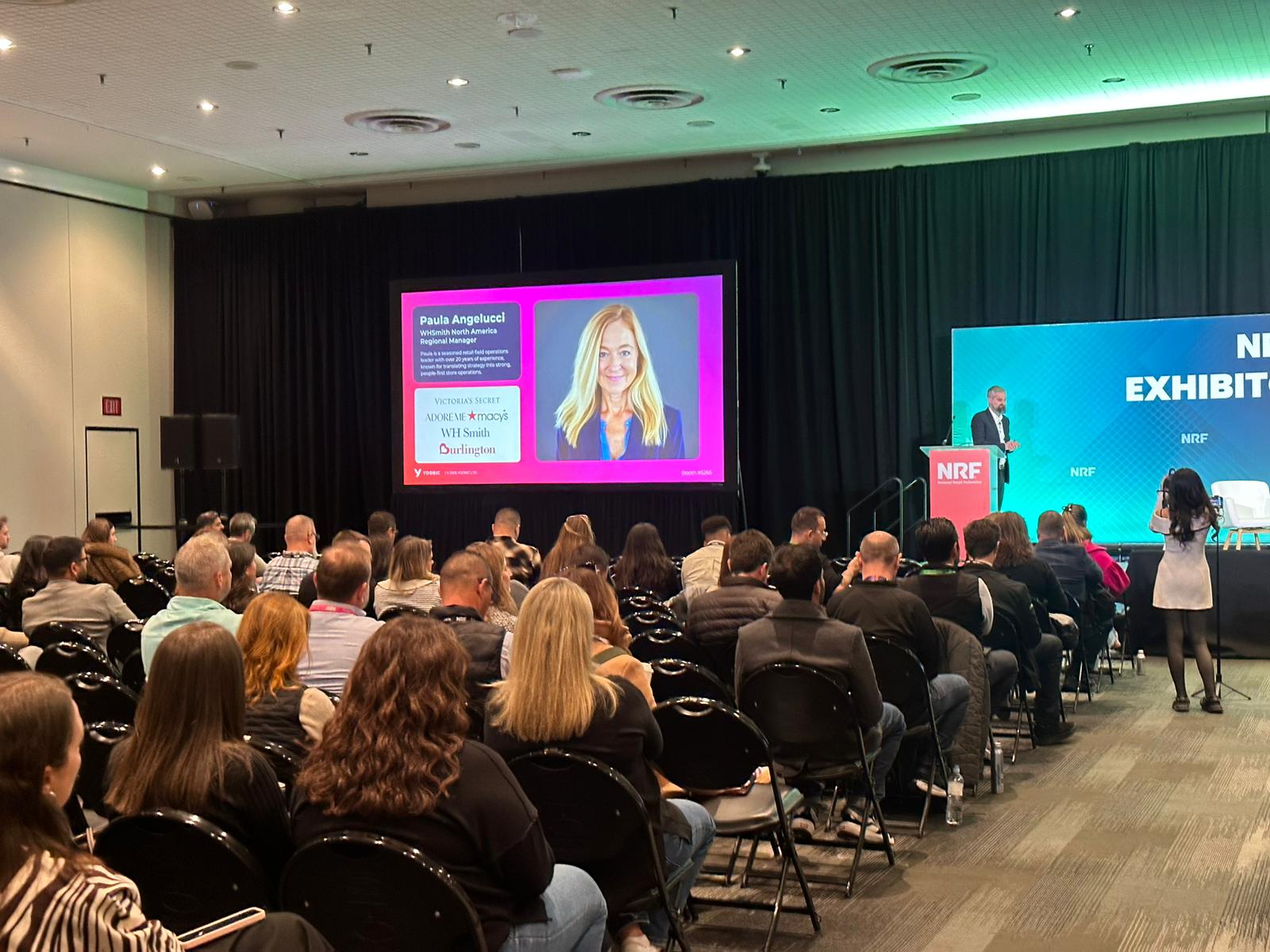


AI dominated conversations at NRF this year. For many retail leaders, the focus has shifted from awareness to application: how advances in AI translate into meaningful change inside stores.
AI is changing retail execution by shifting focus from analysis to action on the store floor. Instead of generating more reports, AI is now helping store managers identify the few actions that will have the greatest impact on performance, each day, in each location. This shift matters because consistent execution, not insight alone, is where retail performance is won or lost.
That shift was the focus of YOOBIC’s Big Ideas session at NRF, which examined how everyday store-level decisions shape performance across retail networks.
Retail execution is the engine for growth and profitability because even with advanced planning tools, 80% of sales still happen in physical stores. AI performance depends on fixing execution gaps—like missed promotions or empty shelves—because poor store execution currently costs retailers millions of dollars through thousands of "tiny, everyday movements".
Physical stores continue to account for the majority of retail sales. Yet many AI initiatives remain concentrated well above the store level — planning systems, executive dashboards, and optimization tools that assume execution will naturally follow.
On the ground, a different pattern plays out.
Promotions don’t launch on time.
Merchandising changes land unevenly.
Teams sell what they know best, not always what the business needs most.
Store managers start the day juggling competing priorities with limited context.
During the session, Fabrice Haiat, Co-Founder and CEO of YOOBIC, described how performance erosion rarely comes from a single visible failure. It accumulates through small execution gaps repeated across hundreds or thousands of locations.
Over time, those gaps become material.
One grocery retailer example illustrated this clearly. Across a 500-store network, incomplete promotion execution resulted in nearly $800,000 annually in penalties — before accounting for lost revenue tied to missed in-store activity.
The challenge here is not clarity at the top of the organization.
It’s reliability on the ground.
AI redefines the store manager's role by providing practical support that handle the overwhelming data and administrative tasks that currently dominate their day. Instead of spending hours as an analyst, the manager becomes a high-value coach and customer expert, using AI as a mini admin assistant to reclaim up to 20 hours of productive time.
Store managers are now responsible for far more than operational delivery. They are expected to coach teams, interpret performance data, maintain merchandising standards, and adapt continuously to local conditions.
The systems meant to support that work often introduce friction instead of clarity.
Paula Angelucci, Regional Manager, East Coast Resort Retail at WHSmith North America, spoke to this reality from experience.
“If we could execute all of this consistently, we’d give store managers back hours in their day, easily.” — Paula Angelucci, Regional Manager, East Coast Resort Retail, WHSmith North America
Much of that lost time is spent navigating information rather than acting on it. Store teams see plenty of data, but translating it into clear priorities remains difficult.
Retailers deploy specialized AI agents as virtual employees that never sleep or get sick, focusing on narrow tasks like visual merchandising and performance analysis. These tools use deep learning and large language models to analyze inventory, sales data, and over 50 million compliance photos to provide real-time store guidance.
What emerged during the discussion was a practical shift in how AI is being used at execution level.
Rather than broad, generalized intelligence, retailers are deploying narrowly trained AI agents designed to support specific store activities. These agents focus on removing repetitive administrative work, highlighting actionable opportunities, and helping high-performing behaviors scale consistently.
As described in the session, this approach positions AI alongside store teams rather than above them.
“We’re moving from reporting to recommending.”
— Fabrice Haiat, Co-Founder & CEO, YOOBIC
Recommendations are contextual — based on inventory, sales patterns, and comparable store performance — and remain optional. Store managers retain judgment, with stronger support behind it.
AI replaces manual dashboard reviews with a smart briefing that summarizes sales, staffing gaps, and task completion within the first ten minutes of the day. It eliminates the need for managers to guess their priorities by providing a menu for success that identifies specific opportunities to move products based on local store context.
During the session, YOOBIC demonstrated how this approach changes the flow of a typical store day.
Before opening
AI-powered briefings surface the few signals that matter most—sales risks, staffing gaps, incomplete tasks — so store managers start informed rather than reactive.
During the day
AI-driven recommendations highlight where small actions can create measurable impact, such as closing category performance gaps by selling a specific number of additional units — grounded in inventory on hand and comparable store performance.
As the week progresses
KPI simulations allow store managers to test corrective actions and understand likely impact before deploying them on the floor.
Crucially, store managers remain in control. Recommendations can be accepted, deprioritized, or skipped based on real-world context. The focus remains on execution that fits the reality of each store.
This approach is already in use. In a proof of concept with HUGO BOSS, store teams using YOOBIC’s Store Manager Copilot achieved:
These results were achieved without changes to staffing or inventory allocation — only improved execution.
Beyond efficiency and revenue impact, speakers noted a shift that is harder to quantify but widely felt: how store leaders carry themselves.
When priorities are clear at the start of the day, conversations change. Morning huddles become more focused. Coaching improves. Execution steadies across locations.
As Paula Angelucci noted during the session:
“When you have the answers in front of you, you hold yourself differently.
You lead differently.” — Paula Angelucci, Regional Manager, East Coast Resort Retail, WHSmith North America
In a labor-constrained environment, that confidence may be one of the most valuable returns AI can deliver.
AI moves teams from insight to action by translating data into clear, practical recommendations for store-level execution. Instead of asking managers to interpret reports, AI identifies specific actions based on store context, inventory, and performance patterns. This reduces the gap between understanding performance and acting on it, while keeping store managers in control of final decisions.
AI will continue to reshape retail. But the clearest signal from NRF wasn’t about more sophisticated analytics — it was about closing the gap between knowing and doing.
The next phase of retail AI won’t be defined by better reports.
It will be defined by better decisions at the edge of the business — every store, every day.
Retail execution refers to how plans, promotions, and priorities are actually carried out on the store floor, day to day, across individual locations. It includes launching promotions, maintaining availability, completing tasks, and executing visual merchandising. Small execution gaps can add up across hundreds of stores and impact performance.
AI is changing retail execution by helping teams move from reporting to recommending. Instead of only showing what happened, AI can surface priorities and suggest actions based on store context, inventory, and performance patterns. This helps stores focus on the actions most likely to improve results.
No. Store managers remain responsible for decisions and execution. AI supports judgment by surfacing priorities and recommendations, which managers can accept, deprioritise, or skip based on real conditions in the store.
Reporting shows what happened. Recommendations suggest what action to take next. This reduces time spent interpreting dashboards and helps managers move faster from insight to action.
Retailers are seeing time savings, improved consistency, and sales uplift from store-level AI. Documented results include reduced time spent navigating dashboards and measurable sales impact from AI-recommended actions. These improvements come from better execution, not changes to staffing or inventory.
Search the blog
Connect with Us




See why 350+ businesses are using YOOBIC
YOOBIC creates a better everyday working experience for frontline teams while helping businesses drive performance at scale.
PRODUCT
See why 350+ businesses are using YOOBIC
YOOBIC creates a better everyday working experience for frontline teams while helping businesses drive performance at scale.


